| |
The Corps of Discovery
p.23 |
| |
In the early 1800s, President Jefferson decided to send out an expedition to explore the lands west of the Mississippi. At the time, it was believed that there was some way to travel by water from the Mississippi to the Pacific Ocean. The main mission of the expedition was to find this water route across the continent. They were to make allies and establish trade with the Native Americans living in the West, and provide detailed information on any new plants or wildlife that they found.
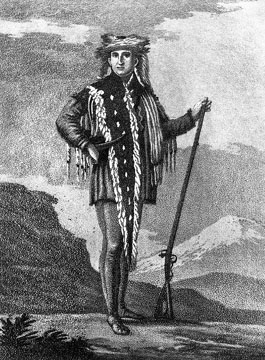
President Jefferson picked his personal secretary, Meriwether Lewis, to lead the expedition. Lewis knew this would be a huge undertaking, so he asked his army friend William Clark to become co-captain with him. The members of the Lewis and Clark Expedition were called the Corps of Discovery. The rest of the Corps was made up of an interesting mix of people that included French-Canadian boatmen; army recruits from New Hampshire, Pennsylvania, and Kentucky; civilian hunters; and a slave named York. There was also a French trapper named Touissant Charbonneau and his sixteen-year-old wife, Sacagawea, a member of the Shoshone tribe, who together acted as a translating team.
During the course of the journey, the members of the Corps traveled for more than two years (1804-1806), covering approximately 6,000 miles. It was not an easy trip. The Corps frequently had to carry their canoes and suffered through cold, heat, mosquitoes, grizzly bears, and lack of food—at one point even eating candles made from animal fat. In the end, there were thirty-three members of the party that stayed with Lewis and Clark for the entire journey, and one dog—Lewis's Newfoundland, Seaman. Only one member of the Corps died during the journey—Sergeant Charles Floyd, who, it is believed, died of a ruptured appendix.
|
|
|
|
|
|


 The Corps of Discovery
p.23
The Corps of Discovery
p.23