| |
Philadelphia
p.70 |
| |
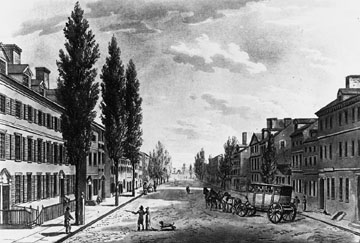
William Penn founded Pennsylvania in 1681. Penn, a Quaker, wanted to create a place with religious freedom and more democratic ways of governing. Guided by his Quaker principles, Penn named the town Philadelphia—Latin for “brotherly love.”
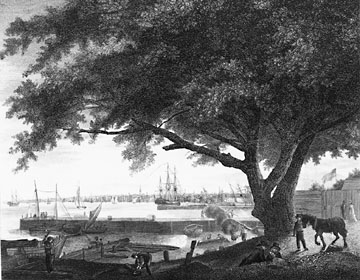
Philadelphia's population steadily grew as people found out about Penn's policies of tolerance, and by the 1770s there were more than 30,000 people living there. However, it wasn't just Penn's tolerance that attracted people. Philadelphia's location, where the Schuylkill and Delaware rivers meet, made it an ideal center for trade and manufacturing. Merchants used the rivers to export goods to England and the West Indies as well as to the other colonies. Other businesses created machinery and tools from Pennsylvania's iron deposits and manufactured steam-powered engines. Later, in the 1800s, the coal industry became vital to the region.
Philadelphia's central location made it a good meeting place for politicians. The First and Second Continental Congresses were held there, and it was also where Jefferson wrote the Declaration of Independence. After the Revolutionary War, Philadelphia became the nation's first capital—it wasn't until John Adams's presidency that the capital was moved to Washington, D.C.
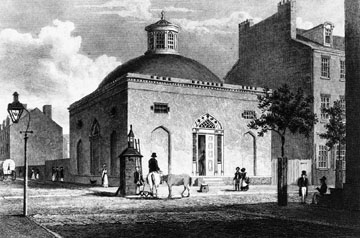
With all of the political and economic success in Philadelphia, it is not surprising that it was also a cultural center and home to much social activism. People in Philadelphia established the first anti-slavery society and it was in Philadelphia that some of the first organizations that helped African Americans in need—such the Free African Society—came into being. Well-known artists and scientists opened some of the country's first museums, and Benjamin Franklin helped to establish the nation's first free library, its first hospital, and the first learned society: the American Philosophical Society.
|
|
|
|
|
|

 Philadelphia
p.70
Philadelphia
p.70