| |
Oliver Evans and the Orukter Amphibolis
p.62 |
| |
Oliver Evans was born in Delaware in 1755. Working as a wagon maker, Evans studied math and science, eventually becoming an inventor and author. In 1777, when he was twenty-two years old, he was hired to make cards, things that worked like brushes or combs, to brush out wool. Attaching the wire teeth to the card was a tedious process, so Evans invented a machine that could cut and mount more than 1,000 teeth per minute.
Evans's next innovation came a few years later, in 1784. He built a factory outside of Philadelphia to grind grain. By adapting several machines, including conveyors and large scales, he created the first fully automated assembly line. His system cut the cost of grinding grain in half.
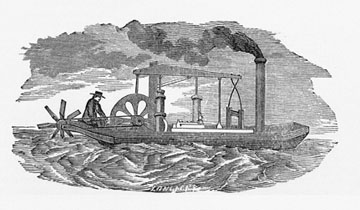
Long fascinated by steam power, Evans's next project was a high-pressure steam engine. He first developed a stationary engine that could be used for industrial purposes. Then he turned his attention to making a steam engine that could be used for transportation. In 1805, he introduced the Orukter Amphibolos, a thirty-foot-long, twelve-foot-wide dredge to clean Philadelphia's waterfront. A cross between a steamboat and an automobile, the Orukter ran on the land as well as in water. It was also the first self-propelled vehicle in the United States.
Evans built the Mars Iron Works in 1806. He built more than one hundred steam engines for processing cotton, tobacco, and paper before the Works burned down. He died in 1819.
|
|
|
|
|
|



 Oliver Evans and the Orukter Amphibolis
p.62
Oliver Evans and the Orukter Amphibolis
p.62