| |
Archeology in the 19th century
p.31 |
| |
American archeology began in the 1700s when people became fascinated with ancient mounds that were being discovered all along the country's east coast. Thomas Jefferson led one of the first archeological excavations to find out who had built these mounds and what purpose they had served. In one mound, near the head of the Rivanna River in Virginia, Jefferson discovered the bones of Native, or First Americans. By working slowly and carefully, marking the bones, and making very detailed notes on how each bone was placed in the mound, Jefferson was following some of the basic rules of excavation that are still used today, and was able to learn much about the burial practices of some early First American tribes.
Jefferson's interest in archeology was shared by his peers at the American Philosophical Society, an intellectual society in Philadelphia founded by Benjamin Franklin in the late 1700s. The Society became home to some of the first archeological collections in America. In the early 1800s, other archeological organizations were formed, including the American Antiquity Society and the Smithsonian Institute.
Large dinosaur bones were also beginning to be discovered around the country. Big Bone Lick State Park in Kentucky is considered the home of vertebrate paleontology in America. Large bones and gigantic tusks were discovered there in the 1700s. In 1807, Thomas Jefferson sent Captain William Clark to Big Bone Lick to supervise a dig. Like the bones of the First Americans that Jefferson had excavated, some of the bones from this dig were housed in the American Philosophical Society; others were kept at his Virginia home, Monticello, where they can still be viewed today.
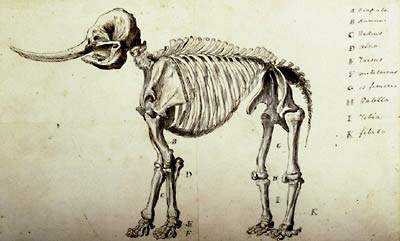
In 1801, Charles Wilson Peale conducted a dig near Newburgh, New York. This excavation unearthed an almost complete skeleton of a mastodon. Peale sent the bones to Philadelphia, where he reassembled them in his museum. This exhibit drew thousands of people and was one of the most visited natural historic exhibits of the time.
News of these bones was very exciting to Jefferson. It was one of his great hopes that the Lewis and Clark Expedition would discover large new species of animals as they traveled westward.
|
|
|
|
|
 |

|
| |
 |
This drawing of the mastadon skeleton that Charles Wilson Peale helped to excavate was drawn by his son, Rembrant.
The American Philosophical Society |
|
| |
 |
 |
| |
Archeological Methods
Find out how archeologists go about identifying sites and their methods for gathering information and excavating.
Where Dinosaurs Lived
Find out where dinosaur fossils have been found in North America and around the world.
Big Bone Lick State Park
Learn about the history of Big Bone Lick State Park and the animal fossils that have been found there.
|
| |
|


 Archeology in the 19th century
p.31
Archeology in the 19th century
p.31