| |
Early American Almanacs
p.28 |
| |
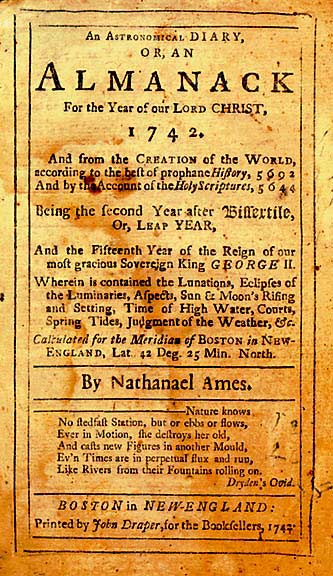
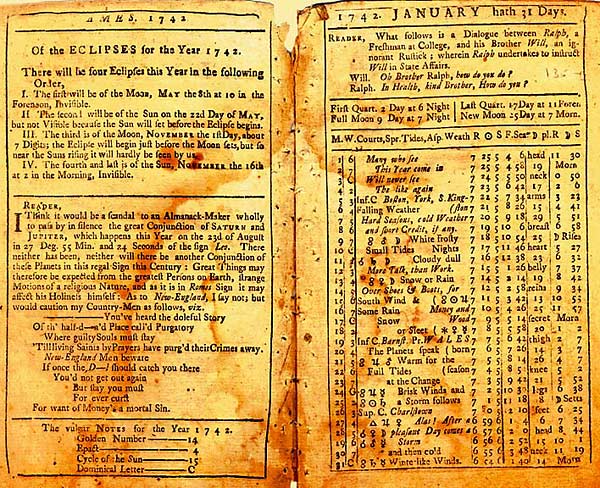
Thomas Jefferson took great pleasure in recording his observations of the climate in his daily weather journal. There were many others, however, who were far more interested in what the weather would be in the future than in observing current conditions. They wanted weather forecasts so they could plan everything from crops to picnics. For this, they turned to one of the oldest type of reference material: the almanac. For the most part, early American almanacs were booklets printed periodically containing calendars with notes about holidays, weather predictions, and astronomical observations. More elaborate almanacs also had maps, political events, and advice for farmers, as well as stories and jokes for entertainment.
Benjamin Franklin's Poor Richard's Almanack, which he edited from 1732 to 1757, was the most famous almanac of the time. Franklin created the comical character of Poor Richard Saunders for his almanac. Poor Richard was always giving advice about life and work. It was he who first said, “God helps those who help themselves” and “Early to bed and early to rise, makes a man healthy, wealthy, and wise.”
However, the most long-standing almanac is The Old Farmer's Almanac. First published in 1792 as The Farmer's Almanac by Robert Bailey Thomas, it is still in circulation today, making it the oldest continuously published periodical in the U.S. The style and format of the almanac hasn't changed very much since its beginnings, and it still gives information on agriculture and long-range weather forecasts, with stories and anecdotes throughout.
|
|
|
|
|
|

 Early American Almanacs
p.28
Early American Almanacs
p.28