| |
Monticello
p.27 |
| |
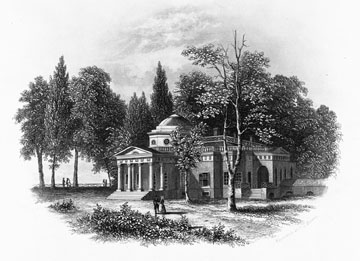
Monticello, Thomas Jefferson's home just south of Charlottesville, Virginia, is one of the most famous houses in the United States. It is a beautiful thirty-five-room mansion made of red brick with white wood trim. One of its most distinguishing features is its large Roman-style dome. It is also known for the many modern gadgets that Jefferson installed. These include a dial on the ceiling that gives readings from a weather vane on the roof; a large clock with two faces, so that it can be read from both inside and outside the house; and a hidden dumbwaiter in the dining room that connects to the wine cellar. Jefferson designed the house himself, and it took many years to build.
Monticello means “little mountain” in Italian, and it is an appropriate name for the building, that sits on top of an 867-foot mountain. Jefferson began designing the house in 1768 and construction started in 1770. The house was almost finished by the time Jefferson was appointed minister to France in 1774. However, while in France he redesigned much of the house, and these new alterations were not finished until 1809.
In addition to the main house, there are servant's quarters, a laundry room, kitchen, and other service buildings. These Jefferson cleverly concealed beneath two long terraces that extend from either side of the house. People could move easily between the terraces and the main house through an underground passage.
When Jefferson died, his only surviving daughter, Martha, inherited Monticello. Unfortunately, she and her family were unable to afford its upkeep and they had to sell the house and grounds. In 1923, the Thomas Jefferson Memorial Foundation purchased the entire estate. Under their supervision and upkeep it has become a much-visited tourist attraction and a wonderful place to learn more about Thomas Jefferson and life in the early 1800s.
|
|
|
|
|
 |

|
| |
 |
Thomas Jefferson had his thirty-five room mansion Monticello built from his own design. |
 |
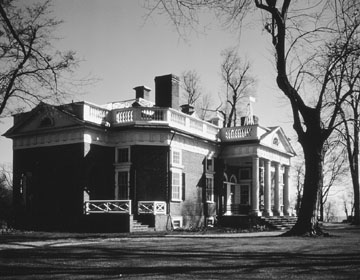
Jefferson began building Monticello in 1770, however, with all of Jefferson's alterations, construction wasn't finished until 1809.
Photograph by Theodore Horydczak |
 |
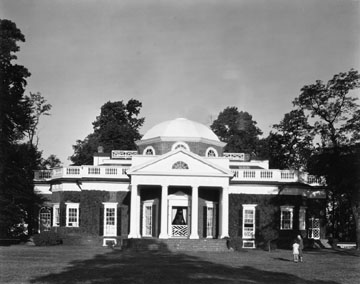
Monitcello can be easily recognized by its red brick, white wood trim, and Roman-style dome.
Photograph by Theodore Horydczak |
|
| |
 |
 |
| |
Life and Labor at Monticello
The Library of Congress's site devoted to Monticello has information about all aspets of life at Monticello from the sale of slaves to plans for crop rotation—it even shows a lock of Jefferson's hair.
Monticello
Explore Monticello on the Web site of the Thomas Jefferson Memorial Foundation.
Jefferson's Library
See a recreation of Jefferson's famous Monticello library, which he sold to Congress after the British burned down the U.S. Capitol and Library of Congress in the War of 1812.
|
| |
|



 Monticello
p.27
Monticello
p.27